Review by Mark Morris
Photos by Felipe Jasso for Calgary Opera
Puccini Tosca
Calgary Opera
Stage Director: Joshua Borths
Scenic Design: Steven Kemp
Costume Design: Robert Perdziola
Lighting Designer: Jason Hand
Floria Tosca: Maria Natale
Mario Cavaradossi: David Esteban
Baron Scarpia: Boaz Daniel
Cesare Angelotti: Philip Addis (Oct 16, Gabriel Sanchez-Ortega)
A Sacristan: Dion Mazerolle
Calgary Philharmonic Orchestra
Calgary Opera Chorus
Cantaré Children’s Choir
conducted by Jonathan Brandani
Jubilee South, Calgary
October 19, 2026
Revolutionary fervour, a torture-loving head of the secret police, summary executions – Puccini’s Tosca, which opened Calgary Opera’s 2026/2027 season in October, may be set in Rome in 1800, but, alas, it could all too easily be set in our contemporary world. Indeed, that world impinged on Calgary’s production on the first night, when Gabriel Sanchez-Ortega was instantly dismissed from the role of the revolutionary Cesare Angelotti after he unfurled a Palestinian flag at the final curtain call. In the subsequent press reports the irony seemed to be completely missed that the hero, and probably the heroine of the opera (both of whom we sympathize with throughout) would have thoroughly approved of the young singer’s actions.
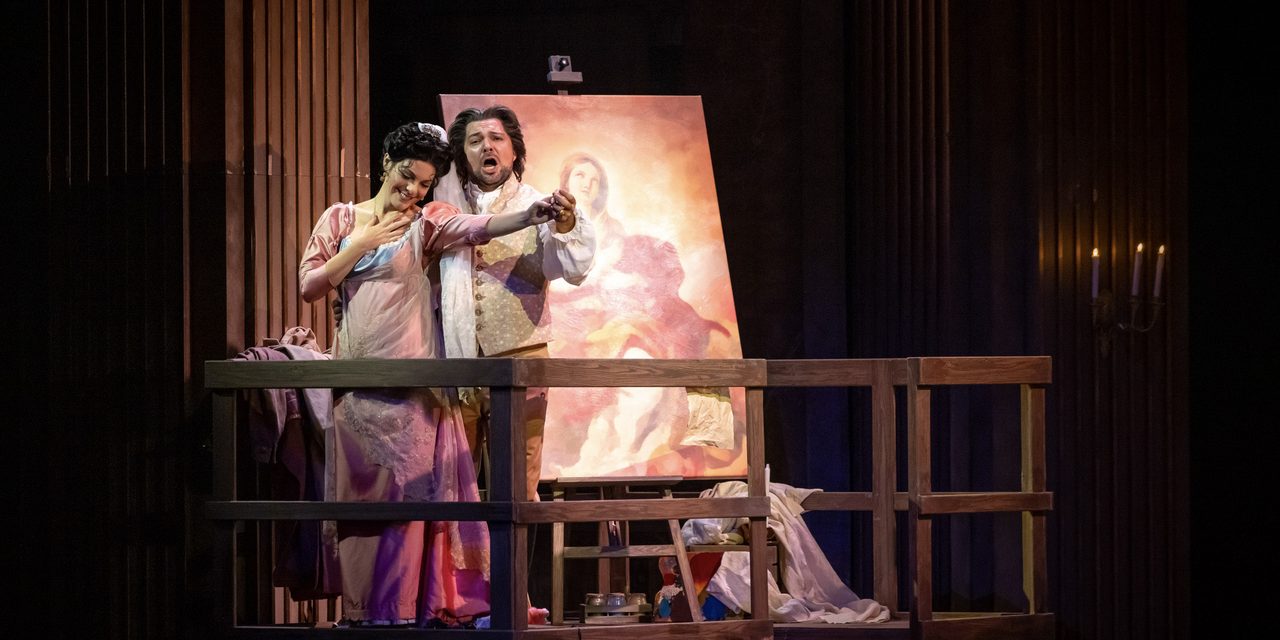
Calgary’s staging, originally designed by Steven Kemp for Des Moines Opera, and costumes, sourced from Cincinnati Opera, Detroit Opera, and l’Opéra de Montréal, were firmly and for the most part very effectively set in the 1800s. The wide Baroque expanses of the real Church of Sant’Andrea della were impressively evoked in Act I, eventually filling up with tourists and priests and church-goers in a powerful and rousing ending in which the chorus (both children and adult) and the orchestra shone – indeed, the Calgary Philharmonic continue to impress with their responsive playing for the opera.
That spectacle apart, Puccini’s opera is not one of grand scale, but rather of intimate, indeed secret relationships between the three main protagonists, and that is what Puccini is primarily interested in. The (historically accurate) revolutionary aspects of Sardou’s play, on which the opera is based, serve merely as the backdrop for the #MeToo horrors of sexual blackmail that forms the core of the story. It thus requires three singers of considerable vocal and acting prowess, and for this production Calgary Opera continued their most welcome formula of introducing notable younger international talent alongside Canadian singers, especially those in the company’s McPhee Artist Development Program.
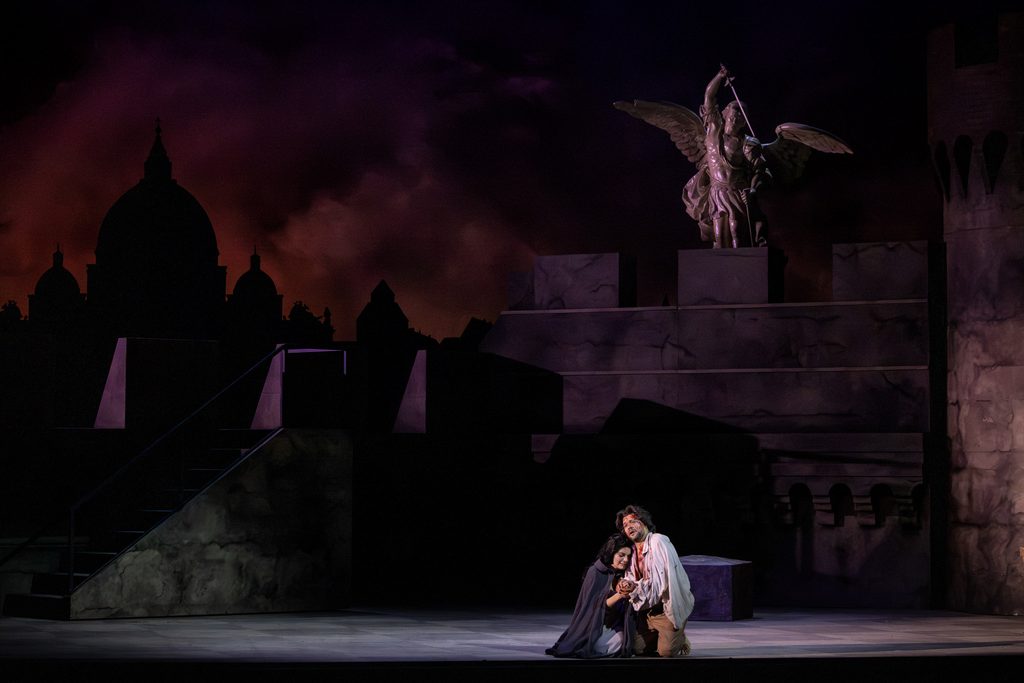
Vocally, this was indeed a very strong cast. Most exciting was the Italo-Ecuadorian tenor David Esteban as Cavaradossi, a true heroic Italian dramatic tenor (his singing reminded me of the younger Mario Del Monaco), with a stage presence to match. Almost as striking was the wide and effortless vocal range of the Italian-American soprano Maria Natale, whose Tosca started out petulant, pouty, and possessive. Both were making their Calgary Opera debuts. Baritone Boaz Daniel, Israeli-born but now based in Vienna, who was Alberich in Calgary’s Rheingold, has the power and the darker colour for the police chief Scarpia.
The lesser roles were equally assured, especially Alberta’s ubiquitous Philip Addis, who presumably had a day to prepare to step into the role of Angelotti, though one would never had known it – he will be returning to Calgary Opera in Massenet’s Cendrillon in January. Canadian Dion Mazerolle, Dr. Bartolo in Calgary Opera’s The Barber of Seville, also impressed in the cameo role of the Sacristan. With firm control (and some swifter tempi in Act II) in the pit from Jonathan Brandani – one gets the sense he really enjoys this score – this was overall a fine and consistent production of high standards, showing the levels a provincial Canadian company can achieve.
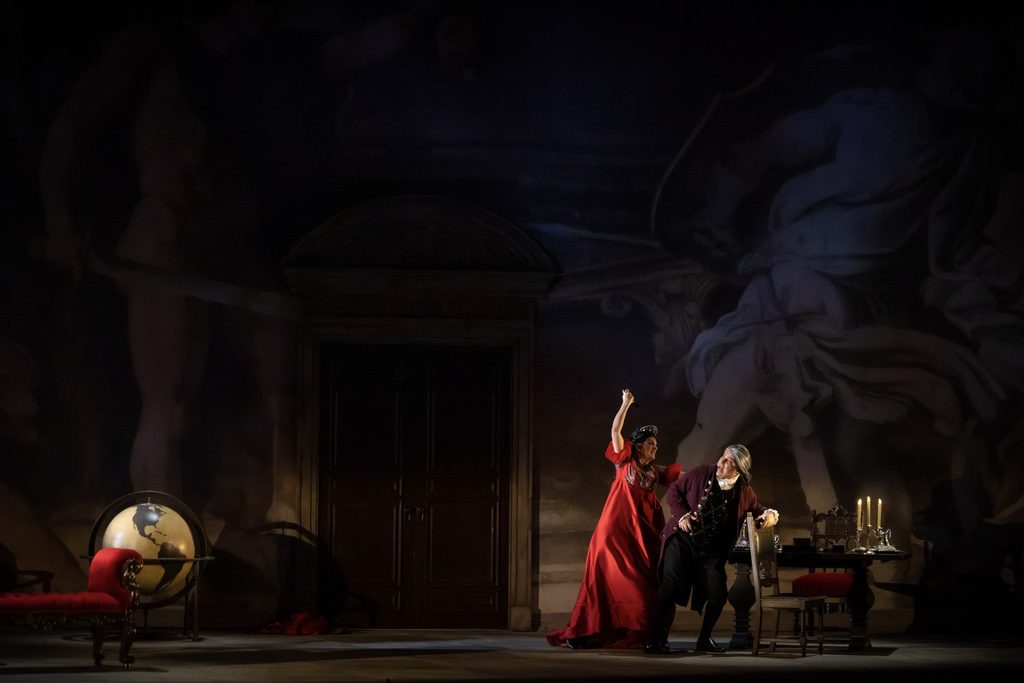
And yet… There were minor niggles – the ‘digitally sampled’ church bells were truly awful (why not use a really good recording?) – but they were indeed minor. But, enjoyable though the performance was, there was something missing. Neither Natale as Tosca nor Daniel as Scarpia, well though sung, really convinced. There was not a huge amount of electricity between Tosca and Cavaradossi in Act I, and that was partly due to Natale’s histrionic stage presence, especially her arm movements. Daniel was simply not evil enough – there was a telling moment in Act II when he went to the globe and gently spun it – it was like an AI generated movement, rather than a human gesture, devoid of the tension of the situation. Part of the problem was the set for that act – the room in the Farnese Palace was unnecessarily gigantic, stretching the entire width of the Jubilee stage, backed by enormous quasi-tapestries (based on Carracci’s Perseus and Phineas in the Galleria Farnese). Tosca and Scarpia were lost in this, the tension dissipated by the demands of blocking in the cavernous space.
By Act III Joshua Borths’ stage direction simply seemed too tame: that extra ounce of passion that would have turned a good production into a really good one wasn’t there.
Calgary Opera’s next production is family-orientated The Pied Piper of Hamelin, with words and by Seymour Barab, on Friday November 13 (7.30 pm) and Saturday 14 (11 am and 3 pm).
website