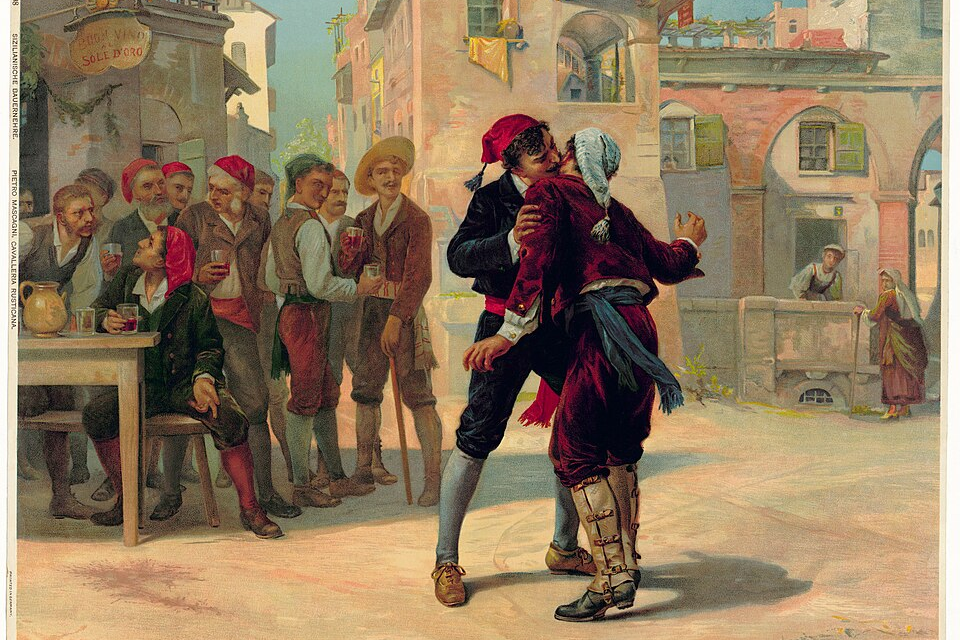
Anonymous, attributed to Rauzzini, Alfio and Turiddu embrace (c.1891)
Pop Goes the Opera presents Mascagni’s opera at the Edmonton Fringe
Review by Mark Morris
Pietro Mascagni (1863-1945) Cavalleria rusticana
sung in Italian with surtitles
Pop Goes the Opera
Directors: Glynis Price and Glenda Sterling
Conductor: Kimberley Taylor-McMann
Santuzza: Alla Salakhova
Turiddu: Andrea Pinna
Alfio: Bertrand Malo
Mama Lucia: Stephanie Bent
Lola: Krista Mulbery
Holy Trinity Anglican Church, Edmonton
August 16, 2026
In 1888 Mascagni was an obscure municipal music teacher and conductor in the town of Cerignola in southern Italy, when he heard about the second Sonzogno one-act competition. It was designed to find new opera composers for the publishing house of the same name, and to create a new generation of Italian opera composers to follow the ageing Verdi. Mascagni had only two months before the submission deadlines, but he decided to enter anyway.
Mascagni’s former student room mate, Puccini, had unsuccessfully entered the first 1883 competition (with Le Villi), but Mascagni had not yet had an opera performed – a condition of the competition. His new opera nearly didn’t get there – he had doubts about its quality, and decided not to submit it, but his wife secretly sent it in on the very last day of the deadline.
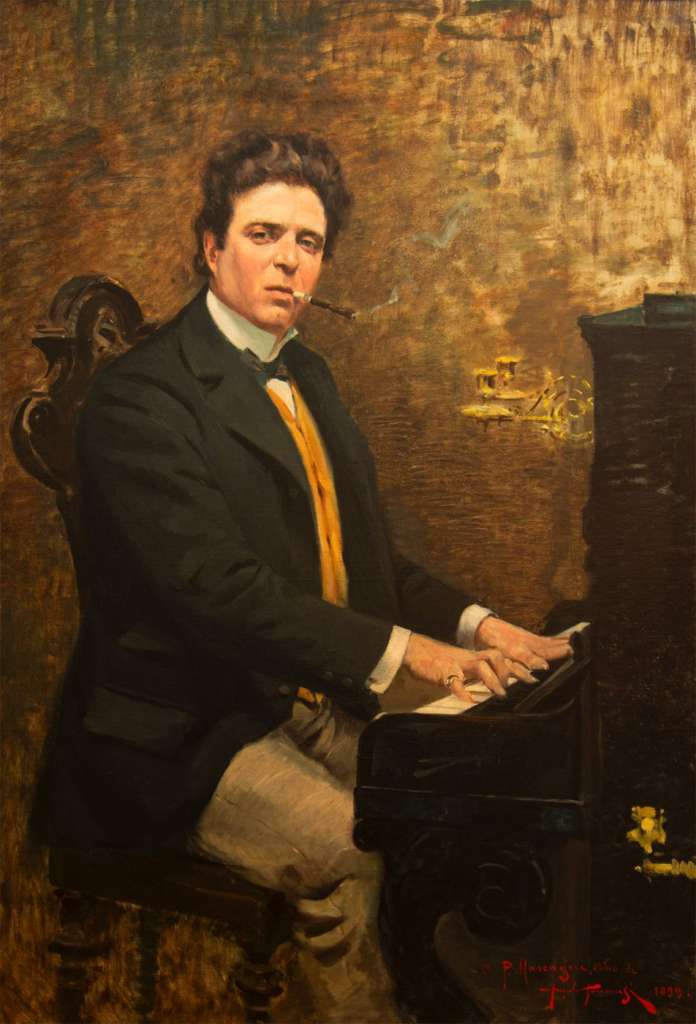
What a good thing she did, for the opera was Cavalleria rusticana, and not only did he win the competition, but its premiere in Rome in 1890 catapulted him into the world-wide fame he maintained for the rest of his life. He had asked the poet and literature professor Giovanni Targioni-Tozzetti for a libretto, and the latter chose a popular 1880 short story (and later play) by the great Italian novelist Giovanni Verga. The story was in the new literary style of verismo, with realistic plots, often about ordinary people, that reflected real life in the raw. It was published in a collection of novellas located in peasant Sicily.
To set such a story as an opera was revolutionary for a medium that had primarily mythical or historical settings, in which such things as peasant life were almost invariably interludes in dramas of the upper classes, or elements of comedy. With Cavalleria rusticana, Mascagni invented verismo in opera, and forever changed what operatic subjects were acceptable.
It is set in a small contemporary Sicilian town, with a basically simple story of domestic dispute and love rivalry, ending in tragic violence. Its genius is first that the characters are musically and dramatically so strongly (and realistically) drawn, and second that this could be any small town in Italy. It could also be, and has been, played in any of Italy’s myriad smaller town opera houses, and the ordinary audience could recognize their own society in the characters on the stage and in their arguments and passions. Indeed, it is the opera being played in the Palermo opera house in the famous last scene of The Godfather Part III.
As such, it also fits in a smaller scale surrounding such as the Edmonton Fringe, and it was the first opera that Edmonton’s Pop Goes the Opera put on at the Fringe a decade ago. To commemorate the anniversary, the company, composed in the main of part-time opera performers of considerable skills who have other full time careers, decided to present the opera once again in their regular Fringe venue, Holy Trinity Church.
The entertaining result was that the whole production, with its strong sense of local community, rather effectively felt as if it was, indeed, put on by a small company in one of those provincial Italian towns. Directors Glynis Price and Glenda Stirling made full use of the church, including both the choir area and the west entrance (from where, off stage, the sounds of the final tragedy of Turiddu’s murder were heard), so that the audience became part of that community. They also successfully fitted in what was quite a large chorus for the small space, and if the orchestra of eight players conducted by Kimberley Taylor-McMann could not not reproduce the rich colours and drama of Mascagni’s score, it did use the church organ – though rather inexplicably, not in the famous intermezzo, where its extra colour and weight were rather needed.
The sense of a provincial Italian company was furthered by the two male leads, both regulars with Pop Goes the Opera. Sardinian-born Andrea Pinna has one of those large Italianate tenor voices and acting styles that hover between opera and Neopolitan song, and which effectively placed his Turiddu firmly in the society of the Sicilian town. In contrast, Bertrand Malo as Alfio clearly belonged to a different strata of society than the rest of the villagers – indeed, in his dark striped suit and with his cigar, he looked as if he had just come back from conducting business in the 1901 New York of Godfather Part II. Malo made the most of it, swaggering like Don Fanucci, innately superior, and just on the edge of hamming it up.
Central to the opera, though, is the wronged, guilt-ridden wife Santuzza. The role here was taken by the young mezzo-soprano Alla Salakhova, who studied at the University of Alberta, recently graduated from University of Maryland’s Maryland Opera Studio, and has now started a professional singing career. She is an excellent actor – her interactions with Pinna as Turiddu really brought home the passions, dilemmas, and isolation of an intimate domestic quarrel. She also has a lovely vocal tone, immediately evident at the start. However, Mascagni’s writing is unrelenting, utilizing all the dark colours of a mezzo voice, but veering up suddenly in dramatic moments into a high soprano range. It is almost invariably sung by a large heavy voice, and when sung by a soprano it has usually been someone like Rita Hunter, famous as Brünnhilde (an exception was Callas, but when she made her celebrated 1953 studio recording, she had sung the role on stage only in her youth, and never attempted to sing it live again).
Salakhova’s voice type is very different (as, judging from her biography, her other roles have shown). Her magnetism throughout the opera was certainly effective, and she has rightly wowed audiences for this Fringe production. But, at least in the afternoon performance I heard, it did feel as if she were pushing the boundaries of her voice – it was noticeable that there were virtually no quieter singing moments in her characterization. She clearly has the potential of a considerable career, but not, one suspects, immediately in this kind of material, however tempting it may be to sing it. I was reminded of a remark by the Croatian dramatic soprano Zinka Milanov, famous for her 1943 Metropolitan Opera broadcast performance of Santuzza (she went on singing until 1966), who, when asked how she maintained such a long career, replied “I never shouted — not even in Cavalleria“. I can’t ever imagine Salakhova actually shouting, but Milanov had a point, and I do look forward to hearing Salakhova in material that is kinder to her lovely voice.
Once again, Pop Goes the Opera has brought both drama and entertainment and, above all, opera to the Fringe, albeit in a pocket format, and once again the sheer verve they bring has been palpable. Long may they continue to do so.